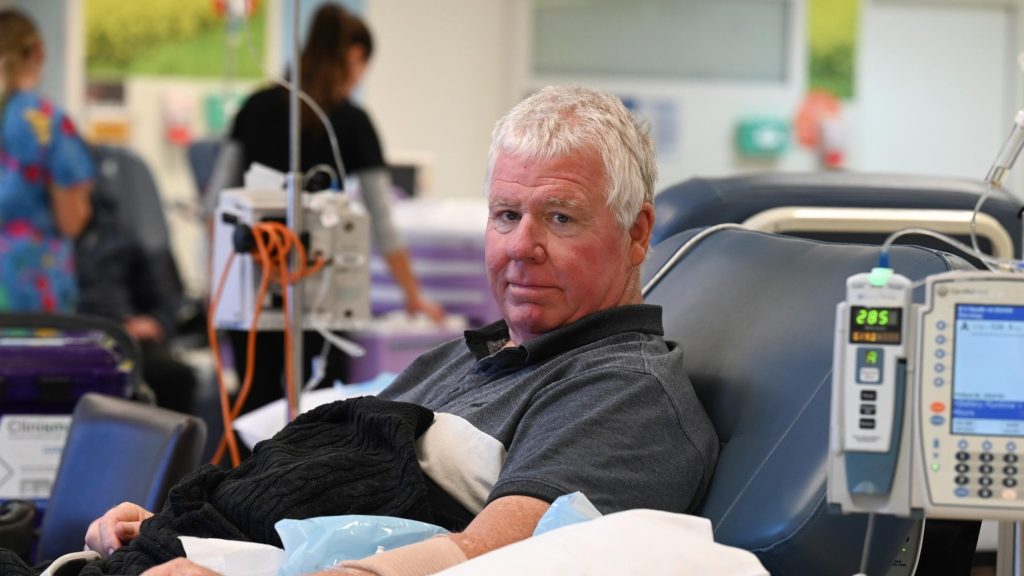

John Harmes was diagnosed with bladder cancer 12 years ago.
Surgeries, treatment, tests and management — in both Shepparton and Melbourne —followed for the next 10 years.
Finally, he was given the all-clear and he, his wife, Jenny, and the youngest of their three adult children, 28-year-old Sam, who has Down syndrome, were ready to embark on a lengthy long-awaited caravan trip.
But, that same celebratory week, cancer had other plans: it wasn’t done with him yet.
On a weekend away near Yea, John was riding his bike to Cheviot Tunnel when he felt discomfort in his lower back.
A conversation he’d had with a cyclist a few years earlier who described similar symptoms ahead of his bowel cancer diagnosis had stuck with him, prompting him to complete a bowel screen test as soon as he returned from his weekend away.
By the end of the week, the results urged a visit to his GP.
“It went south from there and doctors were so quick to get on to it, it became annoyingly busy,” John said.
“So many appointments, time in hospital, recovery, appointments, day here, day there, chemo, chemo, I’ve run out of days off.
“I’ve run out of annual leave, I’ve run out of sick leave, so as much as I want to get back into the workforce because it’s normal — you know, I can be myself when I’m working — I just can’t.”
Once a glazier, now a courier, John said he had a supportive boss, who “went mad” at him when he told her he’d understand her wanting to “get rid of him” due to all the disruptions.
Her sympathy to his situation has meant John’s been able to work around the demands of his treatment and its side effects, including extreme fatigue and brain fog.
“You just run out of oomph at the end of the day,” he said.
After John had his bladder removed 11 years ago, following his first diagnosis, he had some home check-ups here and there, but was administering his own injections every night for 14 nights.
In April, this year, John had his whole lower colon removed during an 11.5-hour keyhole operation performed by four surgeons and four anaesthetists, who had a particularly challenging time due to John’s anatomy being somewhat rearranged after his earlier bladder removal surgery.
He spent a couple of weeks in a Melbourne hospital recovering before he could return home to Shepparton.
While John was grateful many follow-up appointments could be facilitated through telehealth and occasional visiting specialists, Jenny had to take on unexpected nursing duties after the hospital failed to set up regional home care.
John said a local nurse was angered that the care hadn’t been arranged for the couple, but John and Jenny handled the situation with grace.
“We got nice and close, closer than we’d ever been,” John laughed, showing his sense of humour has remained in tact, despite his trials.
“I mean, you talk about for better or for worse.”
But even without having to return to Melbourne frequently, John said it felt like he had always got an appointment, whether it be for urology, surgical or oncology.
“I’ve got a PICC line in (peripherally inserted central catheter that remains inserted for long-term intravenous-delivered treatments) because I can’t get a vein because of previous chemo, so right down to I’ve got to go into oncology every Friday,” he said.
“It takes about half an hour to change the dressing, everything’s got to be so sterile and flushed out.”
The PICC line will remain indefinitely, meaning his weekly appointments also have no current end date.
John’s chemotherapy infusions finish in November before he’ll move to oral chemotherapy, where he’ll have to take four tablets twice a day.
Eventually he might need temporary stents implanted at St Vincent’s Hospital in Melbourne, which will stay for six months before being replaced with permanent ones.
The latter procedure is one that can be done in Shepparton, where he’s most comfortable.
“It’s good to know that here I’m not just a number, you know, like they are seriously all over me, constant phone calls, appointments and the nurses in oncology, all everywhere; they do not get paid enough, they’re amazing,” John said.
“I’ve gotten to know a lot of them personally, ’cause I see them all the time, I know their names.”
John said while his journey had been long and difficult, he was thankful that much of his care had been close to home.
Having had more than a decade dealing with the deadly disease, he takes the daily struggles in his stride.
“I think as an individual, it is hard to go through this, but I often think it’s got to be harder on a family, in my opinion,” John said.
The GV Health Foundation is calling on individuals, businesses and community groups to donate to its $5 million I Care for Cancer Care @ GV Health fundraising appeal to help bring first-class cancer care to the Goulburn Valley.
Donations can be made online.
Community members interested in the various opportunities to contribute to and support the appeal can contact Amy De Paola via email at amy.depaola@gvhealth.org.au